enthralling shell at the odyssey theatre
(a review of in-progress work)
Jeffrey slayton, la dance chronicle (1/28/25)
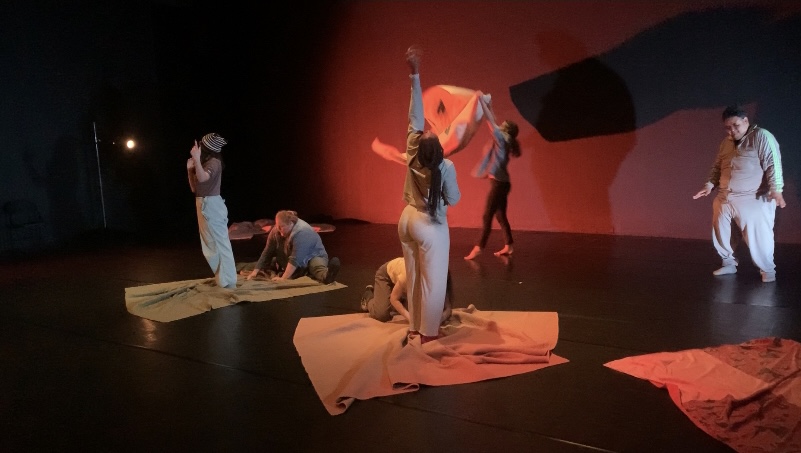
There was the sound of a cardboard box being punctured from within, followed by a hole being cut open like a baby chick pecking its way out of an egg shell. This was the opening of an intriguing, and oddly satisfying work titled SHELL (a draft of new ideas with new folks) by dancer and choreographer ellen smith ahern. It was the second weekend of Dance at the Odyssey Festival in West LA curated by Barbara Müller-Wittmann and produced by Beth Hogan and Müller-Wittmann.
What followed was a series of sections and a film that brought to mind community, empathy, humanity and exploration. Back to the white box, two arms eventually appeared through the now two holes sawed open with a small, serrated knife, one reaching down to the floor to pick up a harmonica, the other reaching into space. Before Ahern emerged from the box, there were chords from the harmonica and Ahern’s small, but lovely voice singing lyrics from a lonely and wistful song.Once set free from the box, Ahern performed a beautiful solo laced with movement that showcased her strong dance technique and beautiful line mixed in with what could be described as awkward, creature-like movement. Side note: Ahern has one of the most beautiful upper back arches I have seen in years.
Following her solo, Ahern sat down in one of the six chairs that formed a circle on stage right and five performers who were seated in the audience joined her for a hand dance and vocalization of sounds sung in harmony. Although it was very intimate, the sense of community definitely came across and this continued as a film involving senior citizens performing similar hand and arm dances with very young children was projected against the theater’s back wall.
There are many, many people in this world that feel that they are not seen and Ahern’s section with some of the performers standing underneath and on top of blankets while the others performed around them clearly reference this. Empathy was shown to these performers as the others made them rotate by turning the blankets underneath those unseen, demonstrating that yes, you are seen.The work ended with the white box being moved center stage, turned on its side and Ahern and her assistant hurriedly placing tiny furniture and lights inside. Although there was humor involved, this section bordered on the absurd as Ahern shouts, “I’m going in!” Going in to do what was not clear, but the urgency definitely came across.
During the Talk Back following the performance, we learned that SHELL was created in just two days. Ahern worked with Müller-Wittmann to find five Los Angeles artists and with strict directions from Ahern, created a collaborative map for all of them to follow. The timeline was set and clues to shift from one section to another, but within that framework the performers were allowed to improvise.Watching SHELL, I never would have guessed that this group only met five days prior to their two day rehearsal period. Yes, the improvisation was evident but the work appeared well rehearsed and polished. This says volumes about the planning Ahern had done and the trust that she instilled in her colleagues. Not everyone could pull this off so clearly Ahern knows what she is doing and how to accomplish it.
SHELL was Designed and Directed by Ellen Smith Ahern, and the lighting was Designed by Katelan Braymer. The cast included: Ellen Smith Ahern, Jaz Dicey, juan mendoza, Doug Goldstein, Lise Hart, Jennifer Jonassen, and Constance Strickland.
Local artists create sound-based performance art
avery lin, the dartmouth (10/28/24)
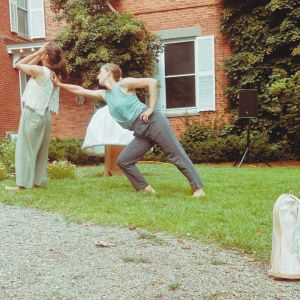 With support from the Artist-in-Residence Program at the Marsh-Billings-Rockefeller National Historical Park in Woodstock, Vt., artists Ellen Smith Ahern and Menghan Wang have collaborated to create innovative soundscapes, which they plan to incorporate into a performance art piece. The soundscapes were drawn from natural sound recordings from the national park forest.
Smith Ahern — a dance artist and community organizer who lives with her family on Abenaki lands in N’Dakinna, N.H., according to her website — began her residency with the park at the start of this calendar year. According to Interpretation Program supervisor Kelly Sczomak, who helps with the Artist-in-Residence program, Smith Ahern is the only performance artist to be an Artist in Residence in her memory.
Sczomak said Smith Ahern has “brought a really special energy to the program” – adding that she has especially emphasized local community engagement in her work, drawing from her “community organizing background.”
“I’ve learned she has this incredible innovative approach to bringing diverse artists together, and that was her priority,” Sczomak said. “Day one, she [was] like, ‘Is there any way that I can get more people in my community involved?’”
Expanding on this community-centered philosophy, Sczomak said Smith Ahern and collaborating artists presented a “gorgeous” interdisciplinary performance art piece, “Vulture Sister Song,” in front of the Marsh-Billings-Rockefeller mansion for a free community program in July. The dance performance art piece focused on “telling stories about vultures” and “thinking about vulture imagery [and] vulture[s’] role in the ecosystem,” according to Smith Ahern, who participated in it as a dancer.
More recently, Smith Ahern has collaborated with Wang, an active local artist who was introduced to Smith Ahern via a mutual friend. The two created a trio of soundscapes built from recordings from three different locations along a park trail they named the “Ecotone” trail.
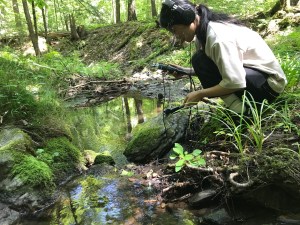 Wang said she used various techniques to record the natural sounds in the forest environment from unusual perspectives. These spots were specifically chosen, she added, from Smith Ahern’s observations of “interesting acoustics” there.
In one recording, for instance, Wang submerged a hydrophone — an underwater recorder — in a brook. For another, she installed a geophone — an acoustic recorder — on a tree trunk to record the “creaking sounds” made when wind blew through the tree.
“We were interested in those locations as the intersections of two or more natural spaces [that were also] liminal spaces,” Wang said.
After collecting the sounds, Wang said she refined them in post-production to create sound compositions that ultimately sounded either “harmonious” or “disharmonious.”
The compositions feature some human noises — namely Ahern’s humming in one recording and the sound of passing carriage horses in another — as well as one sequence in which Ahern plays the harmonica inside a tunnel, Wang said.
However, the musical quality of the compositions stems not from the instruments, but rather the naturally recorded sounds whose frequencies were altered in post-production, according to Wang.
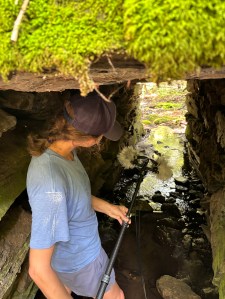 “I was thinking [that] resonance, despite just being a physical vibration, also can be a form of empathy,” Wang added. “Basically, we hear sounds because our ears are vibrating as a medium that vibrates with the sound transferred to our ear. … So I was really interested in this [idea that] maybe other species actually understand this naturally.”
Smith Ahern said she has previously worked with sound in collaboration with vocal artists and musicians. However, she said this process of using collected “organic” sound has marked an exciting new direction in her work.
“It’s been really, really fun and exciting over the past few years to work with folks, both with acoustic instruments and voice, and [to] then sort of head into this realm where we’re collecting environmental sound, which is so organic, and weaving that into electronic music and soundscape,” she said.
Smith Ahern also mentioned that the project has introduced a fresh perspective on a subject that has long been meaningful to her: the “interdependence and interrelationship” between humans and nature.
“I think that my work has definitely been sort of spiraling around and intersecting with nature and humans inside of nature and our relationship with it,” Smith Ahern said.
Wang, who has previously created work for the Climate Care Festival in Berlin, said she was drawn to the project because of her interest in the natural world and because she had “always [been] interested in working with dancers.”
Since 2007, the Artist-in-Residence program has supported the park’s mission of “tell[ing] the story of conservation history and the evolving nature of land stewardship in America,” according to Sczomak.
“The program is special because we have the opportunity to connect visitors with the landscape through art and creativity,” Sczomak said.
For each visitor season – which lasts from May through October – the park selects a few artists — up to three starting in 2023 – for the residency, according to the national park website. Sczomak explained that artists are chosen based on their potential to enhance visitor engagement and to run engaging public workshops. After being awarded the position, they are given “a lot of autonomy” over their work, according to Sczomak.
Unlike other national park residency programs, the park does not “expect a [tangible] product at the end” from the artists, Sczomak added. Instead, they are required to simply engage with the community, whether by participating in public events, hosting a workshop, opening up their studios or showcasing a temporary exhibit of their work.
Instead of stipulating a required tenure length, the park sets a minimum requirement of 100 hours, which may be filled by a combination of art-making and community engagement, Sczomak added. The artists commute to the site.
The three sound compositions are currently available for listening as part of a self-guided tour available for free download via the NPS app on the Marsh-Billings-Rockefeller page, which Sczomak encouraged park visitors to use.
Smith Ahern said the artists’ short-term goal was helping visitors foster “deeper” engagement with their surroundings — to “open up curiosity or even emotions.”
Meanwhile, Smith Ahern said she and Wang will continue to develop this sound art. The two are currently working on creating a performance installation piece incorporating these compositions, she said. In particular, Wang said that they seek to “recreate” the feelings evoked by the three trail spots in a space physically removed from the park.
Ahern said that they hope to create an accessible path similar to the “Ecotone” trail that audiences can follow. The experience will feature a “movement” – specifically dance – component enhanced with lighting design.
This performance installation will be presented at 6 p.m. on Monday, Jan. 6 in The Main Street Landing Black Box Theater in Burlington, Vt. as part of the INSTINCT Festival.
The two also plan to give a performance at Crumb Factory in Montpelier, Vt., in the coming months. Crumb Factory is a budding artist collective featuring gallery and studio space, according to Wang, who joined the collective this year.
through dance, music & storytelling, vulture sister song explores humans & nature
hannah feuer, seven days independent newspaper (07/03/24)
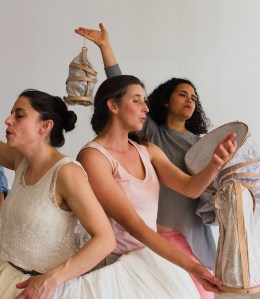
free to gather again: vulture sister song at ava gallery
Susan B. Apel – artful: arts & culture in the upper valley (03/31/23)
Then, and now. The pandemic may not be entirely over but things have changed. Delivered packages no longer sit untouched for three days in the garage for fear that the virus lives on cardboard. No more swabbing canned goods with disinfectant wipes before bringing them in the house. No longer scrambling for vaccine appointments. Sometimes I look back on the last three years and am startled that I have forgotten some of my own lived history of the time: the stuff of stories you will tell your incredulous great-grandchildren. Once there was a time when an art gallery, like all cultural gathering places, had to shut its doors and remain vacant for longer than anyone could have foreseen. Windows—great big ones— however, are not doors; hence their particular power. And so there came a time in March, 2021, when a lone dancer danced in an empty gallery, and we all viewed the performance from the outside, peering through the glass. Who could have imagined? That dancer, Ellen Smith Ahern, is no longer alone and the doors at AVA (and just about everywhere) are once again open. “The lone dancer not only represented a missing audience within the galleries, but also a poignant reminder of community and togetherness that we had in the past taken for granted.”
|

AVA Gallery: Dance, Through the Glass
Susan B. Apel – artful: arts & culture in the upper valley (03/09/21)
You could be on the outside looking in, but in a good way.
I have distinct memories of the welcoming nature of the big, beautiful windows at AVA Gallery in downtown Lebanon NH. A winter or so ago, my husband’s and my toes were frozen as we limped through the dark from a holiday market on the town green to an opening reception at AVA. The windows shone like marmalade and the light puddled onto the adjacent sidewalk. A postcard moment. We were toastier just for the sight.
AVA will be opening two exhibitions in honor of women’s history month, featuring female sculptors, one a group show with Christine Hauck, Ellen Keene, Amanda Sisk, and Heather Szczepiorkowski and another by artist Stefania Urist. In lieu of an opening reception, AVA will feature a performance by dancer Ellen Smith Ahern on Friday, March 12 at 6:30 pm; the performance is designed to be viewed through the (newly-washed) windows.
Ellen Smith Ahern has danced throughout the world and is a new resident of Lebanon NH. I shared with her my passion for AVA’s windows while wondering about the challenges of performing on the other side of glass that separates her from her audience. Her response acknowledges the limitations but also the potential of this new venue.
“The windows were AVA’s idea, and I’m excited about them, both as a challenge and an opportunity to connect in an unconventional way. . . As an artist, I’m always curious about how dance making can be a journey for both the dancers and the viewers—I like to be able to see my audience up close, hear them, interact with them and feel how their presence shapes my work. So yes, performing behind glass is a limitation in some ways.
I’m hopeful though that, with a sense of humor and a willingness to try to connect despite the barrier, viewers will get to experience the sculptures and the dancing in a fun, thought-provoking way. Maybe we can all get something fresh and new out of what feels like a very challenging, fatiguing year of distance. I think that another delightful aspect of this event is that it opens up the worlds of performance and visual art, both of which can be exclusive, to truly anyone passing by on the street.”
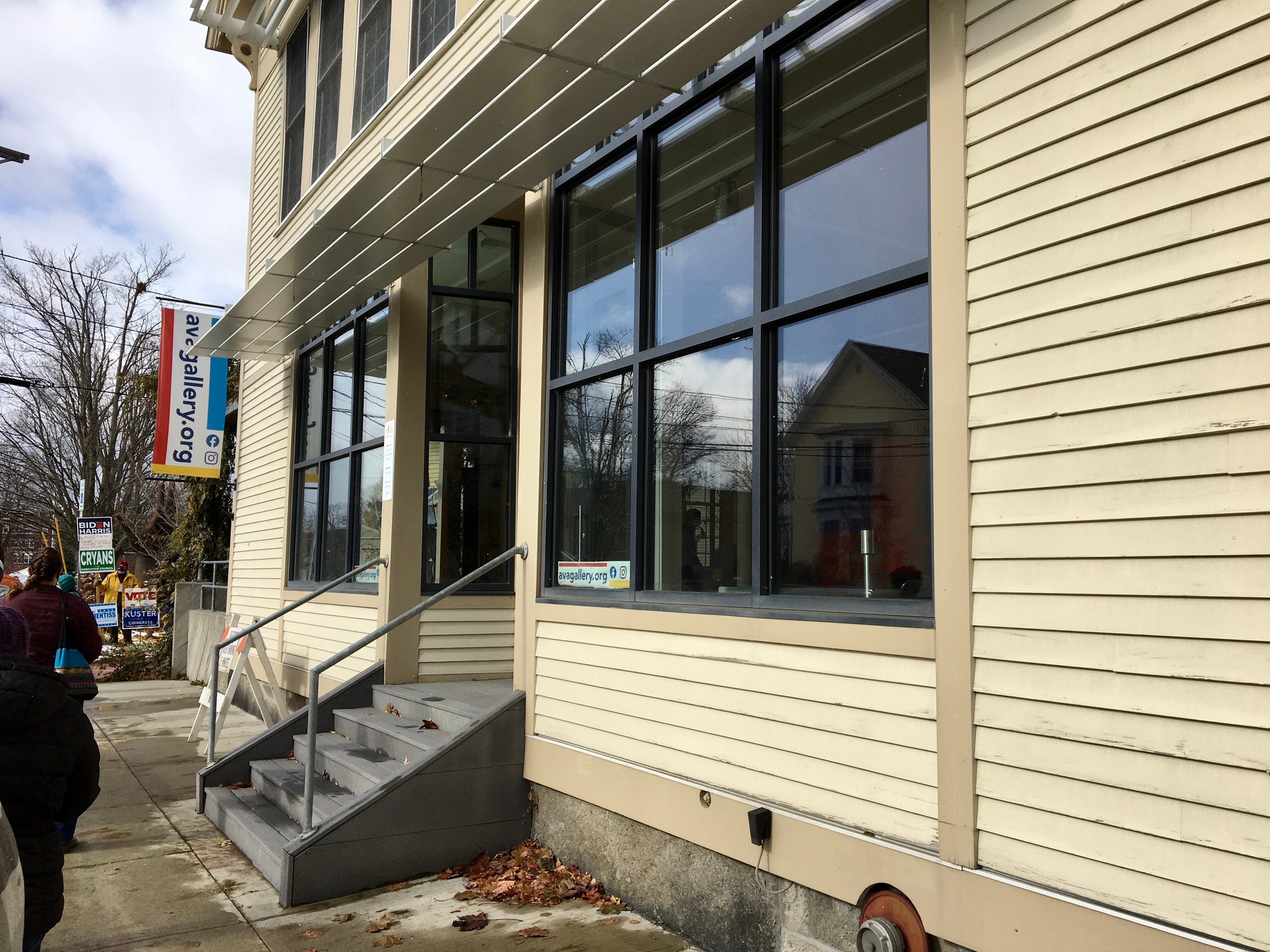
Audience members and passersby who stop to view are asked to wear masks and socially-distance. AVA will also make the performance available via Zoom. To sign up for a Zoom link, and to learn more about the exhibitions and artists, please click here.
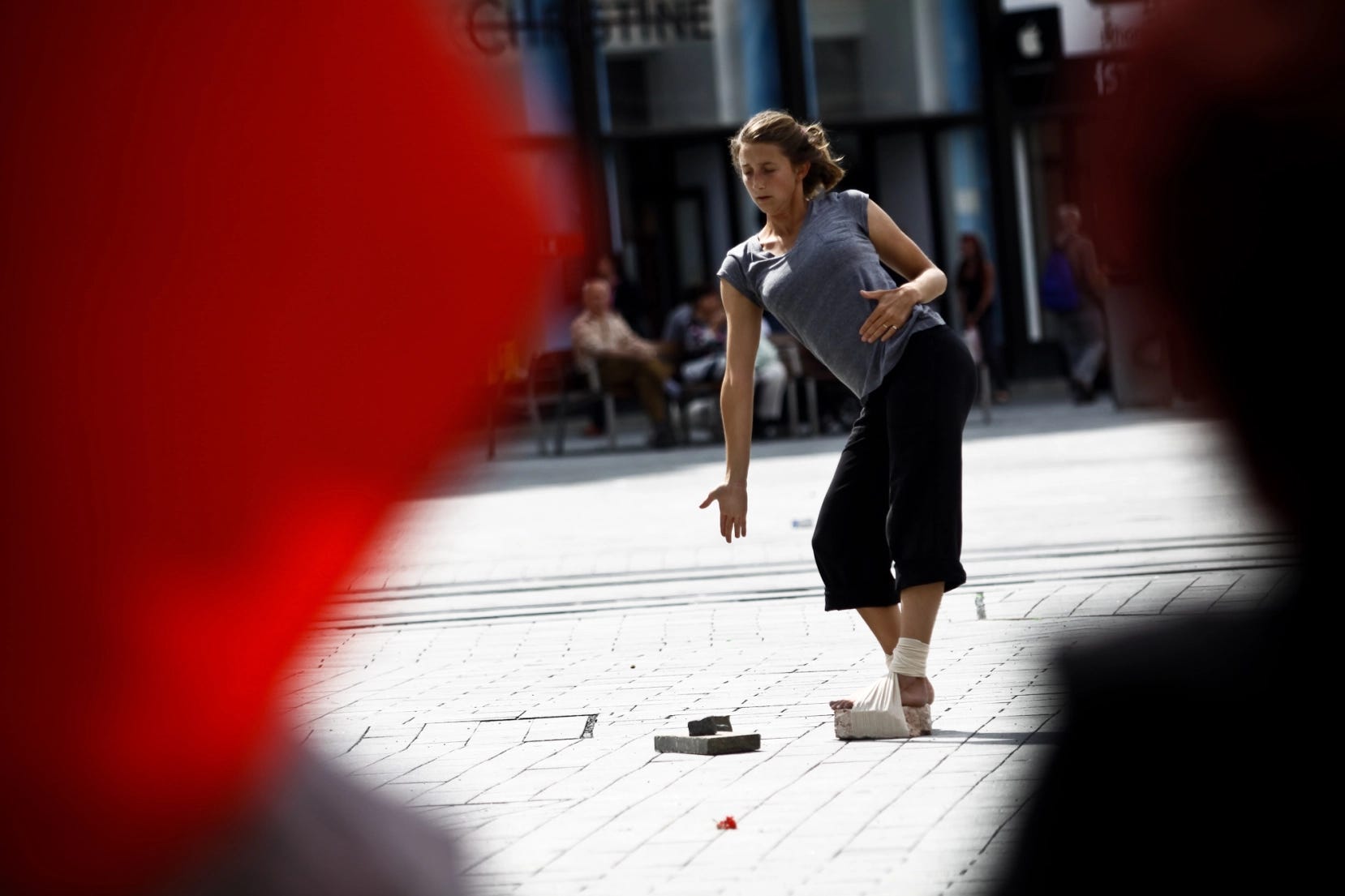
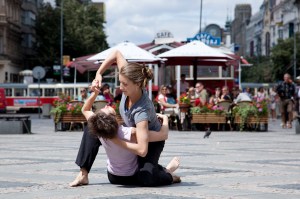
(Photo, top, is of the artist dancing in Brno, Czech Republic in 2011. Photo credit: Marek Prochazka.)
______________________________________________________________________________________________
Middlefield Art Installation Deals with Identity, Change, Belonging
Arts Preview by Bailey Wright, Record-Journal, Meriden CT (10/29/18)
MIDDLEFIELD — A one-day art installation next weekend seeks to create a community conversation about identity, change and belonging.
“Hopefully it’s going to be a dialogue between the material we collected out west and the material I’ve collected here in the east…, (and) how we think about who we are and where we live… and the people around us,” said Ellen Smith Ahern, the lead artist and a Durham resident.
She added that the project, called “East/West” encompasses many walks of life.
The free interactive installation will be open Nov. 10, from 4 to 7 p.m. at the community center, 405 Main St. A family-friendly dance party with DJ Red Supreme will follow.
The display will feature several stations for visitors to interact with the material, including a dance film, audio interviews, and an opportunity to record stories or memories.
At one station, a local art teacher will lead the making of a paper quilt. Visitors will also be able to markup maps of the east and west locations. Coginchaug Regional High School students are also expected to contribute.
“We really want to offer people an experience with multiple points of access,” Smith Ahern said. “So if dance is not your thing and you want to watch it for a little bit, but you don’t feel like it brings you in or it resonates with you, there’s four other windows into the work.”
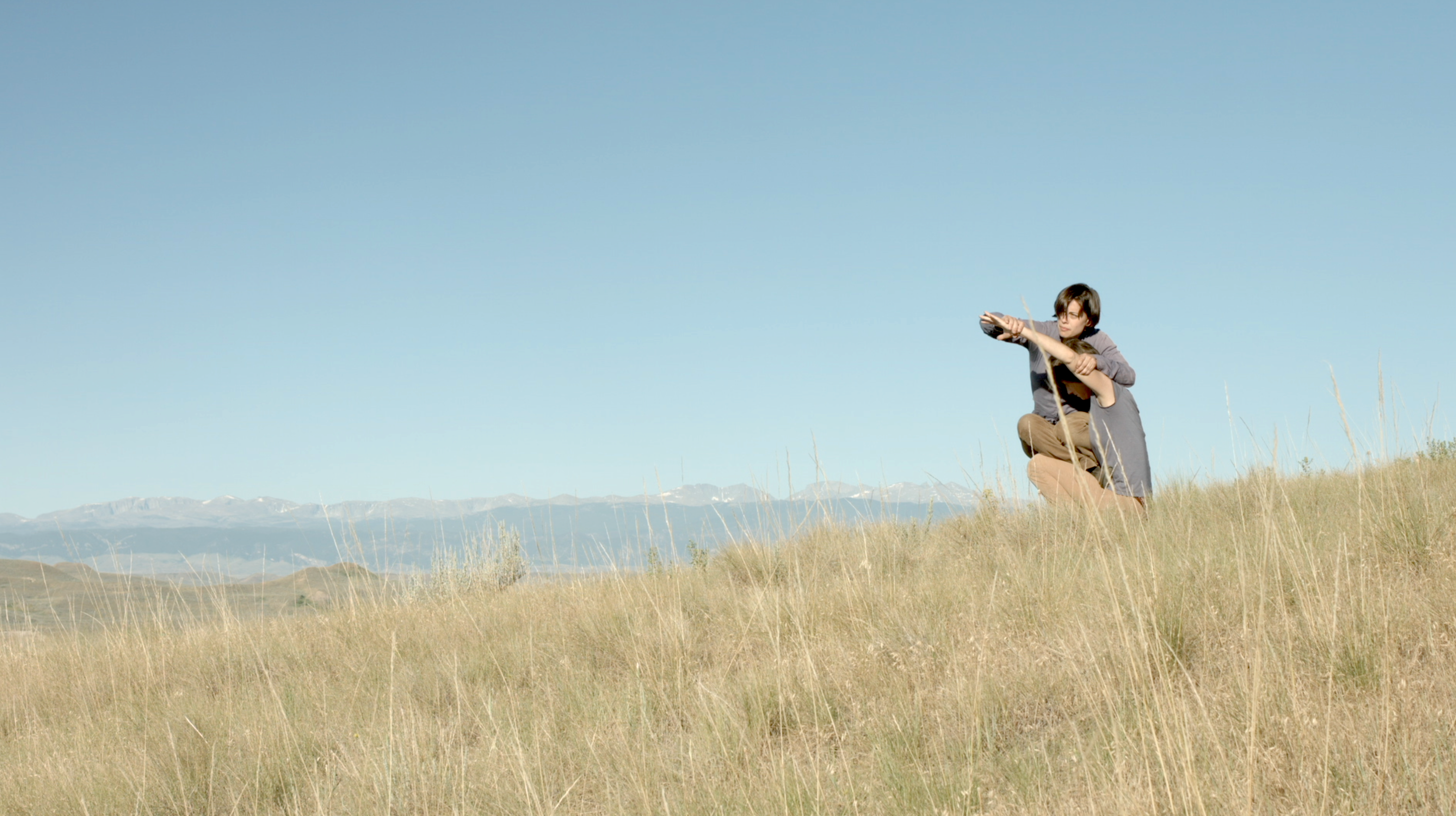
The project was first created about 10 years ago when Smith Ahern and a friend from college started putting together a duet performance piece with a playful take on the west, titled “3D Western.” The piece has since continued to evolve and was filmed while the two did a two-week residency at an artistic foundation in Wyoming about two years ago.
While in rural Wyoming they interviewed a variety of locals, including wildlife biologists, range specialists, an antique seller and a Native American studies professor.
“It’s been really a very challenging process, but really fulfilling and interesting,” Smith Ahern said. “As the social and political climate has shifted in the last couple of years, this kind of project to me feels really important because we have so many perceived differences dividing us… I think that some of those differences are real and some of them deserve a closer look.”
Next weekend’s event took life more than a year ago when Smith Ahern applied for a grant from the Coginchaug Valley Educational Foundation.
Nancy Earls, the foundation’s president, said the proposal was unusual, unique and ambitious.
“It’s going to be a really thoughtful presentation that people can talk about,” she said.
The local part of the project involved 30 interviews with people ages 6 to 101.
“I think this is an important story to tell because we’re actively questioning our local and national identity right now and we have the opportunity to make social and political choices that are inclusive, that acknowledge that those of us who are not Native share a connection on some level as immigrants,” Smith Ahern said.
Smith Ahern’s creative partner Kate Elias, who resides in Seattle, will attend the event at the community center.

————————————————————————————————————————————–
A Dance About Death, and Life, with Humor
Featured Arts Preview by Megan James, Seven Days newspaper, Burlington VT (09/12/12)
http://www.7dvt.com/2012dance-about-death-and-life-humor
The latest dance-theater work from choreographers Lida Winfield and Ellen Smith Ahern, Long Gone, springs from one simple concept: All of us come from a long line of dead people.
In their evening-length piece, which debuts at FlynnSpace this weekend, the duo, who collaborated in Vermont for several years — and have continued to create work together after Smith Ahern moved to Long Island last year — use movement and storytelling to explore memory, lineage and death.
“You know when you look at a photograph of people who maybe you never knew, who aren’t alive anymore?” Winfield says. “You have a story you make up in your head of what happened: where they were, who they were, what they said, how they stood.” The pair wanted to explore the effect of that phenomenon, how those thoughts about the people who came before us become part of our memories — and our identities.
When Winfield and Smith Ahern began working on the piece a year ago, they looked to their own families for inspiration. But soon they realized they needed to broaden their perspective if they wanted to strike a more universal tone. So they held storytelling workshops in which they encouraged participants to dig into their own memories. Some of the resulting images and concepts made their way into Long Gone. So did audio recordings of Smith Ahern’s grandparents and an intriguing sequence the choreographers call the “death song.”
It was important to both Winfield and Smith Ahern that this death-centric work wasn’t just doom and gloom. “We all know people who are dead who were terrible,” offers Winfield wryly. They took on the challenge with a sense of humor: “Could we make a piece about death that wasn’t exclusively about loss? And could it be not heart wrenching? Could it be funny and awkward?”
In one solo piece, Smith Ahern re-creates a visit to a grieving friend’s house, armed with lasagna and an arsenal of socially acceptable condolences. “But when the person opens the door and their father just died, and you say, ‘I’m so sorry for your loss,’ the words can feel really flat, or weird,” Smith Ahern says. “They don’t begin to cover the loss.”
Another piece is inspired by Winfield’s own story of losing a loved one as a teenager. The scene plays out, she says, after “the funeral is over and everyone’s gone.” Like many a tormented teen, she blares Led Zeppelin and decides she’ll never survive.
And then she has an epiphany. “I wanted a bagel and a cup of coffee,” Winfield recalls. That simple craving “was a reminder of how good it is to be alive, how amazing it feels to survive hardship, how powerful that is.”
Long Gone looks back on those who have died, but it also celebrates the joy of living. After all, for most of the time the work was in development, Smith Ahern was pregnant. That offered poignancy — not to mention a whole new movement vocabulary — to the dances.
“It was really interesting to make a piece about death while Ellen was making a baby,” Winfield observes.
“My immediate thought was that it was going to be a real hardship in the creation of this piece,” adds Smith Ahern of dancing with a pregnant body. “Actually, it turned out it was kind of a gift.”
‘Ellen Smith Ahern and Lida Winfield
At a recent rehearsal for their upcoming show at the Firehouse Center for the Visual Arts in Burlington, Ellen Smith Ahern and Lida Winfield look like sisters. Physically, they’re quite different — Smith Ahern, 27, is about half a head taller, with dirty-blonde hair and dewy eyes; Winfield, 32, is tiny, with the dark hair and fair complexion of a porcelain doll.
But the way they move — climbing over each other, slamming their chests and mimicking each other’s 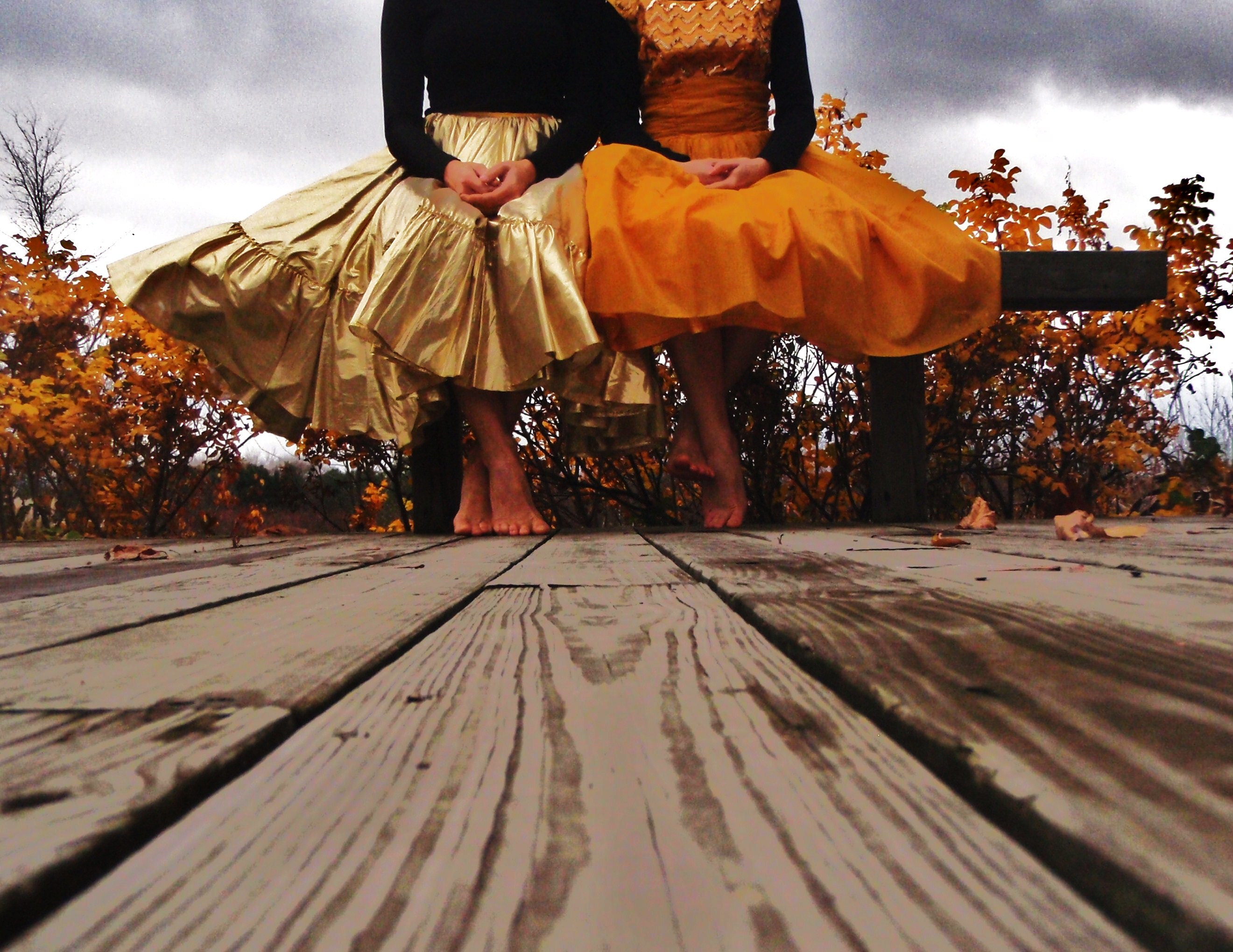 curious gestures — has the playful intimacy of children exploring the world together.
The Burlington dancers recently formed a creative collaborative in the style of a CSA — instead of community-supported agriculture, they’re talking community-supported arts. Members who invest in the duo’s dance making will receive tickets to shows and invitations to participate in dance workshops and attend open rehearsals.
The two performers came to dance from different perspectives. Smith Ahern grew up in Illinois, where she trained in ballet. When she discovered modern dance in high school, and later at Middlebury College, she knew she’d found her calling.
“I was getting the message from ballet that my body wasn’t right for it, for a number of reasons,” she says. “So it was liberating to find this other dance form.”
Winfield grew up in Vermont and took classes in jazz and modern as a kid. “I really wasn’t very good,” she says. “I was often sort of the kid in the back.” Unable to remember the steps the teacher taught, she’d often just make things up. It wasn’t until she started participating in the creation of movement that something clicked. At 14, she was one of the youngest members of Hannah Dennison’s company, Working Ground.
Winfield and Smith Ahern met while performing in UVM dance prof Paul Besaw’s dance collaboration with the Burlington Chamber Orchestra last year and sensed they would work well together. Both have a taste for the awkward and ugly, as well as for the beautiful. And they’re both driven by the sense that this is it: They want to make a living from dancing.
“Our drive is similar,” Winfield says. “That is, the joy and also the heartache that comes with being an artist.”
The piece they’re presenting as a work-in-progress at the Firehouse — and before that in Montpelier — was inspired by a dead hawk Smith Ahern found frozen in a tree, its eyes open, talons wrapped around a branch, at the Intervale last year.
Talking about the piece and its origins, Winfield muses, “I always believed our bodies hold more truth than our words ever can.”
Smith Ahern says she dances because of the sense of freedom it gives her.
“I really love the idea of how much time and effort and thinking and emotion — and sweat! — goes into creating something that is gone immediately,” she explains. “This fantastic practice of creating something that you really care about, that you’re also willing to just let go.” ‘
———————————————————————————————-
Footage above is from ‘Critical State’ 2010 – stay tuned for footage from 2011’s performance… the following is an excerpted review from 2011:
Read the full article at critical-state.html
“…The venue, River Arts, is an intimate two-story building that feels more like someone’s home than an art center. But Motley and her collaborators — five dancers, one composer, four video artists, one lighting designer — essentially transform it into a mixed-media fun house. The performance runs for three hours, but the action ebbs and flows, swelling in one room until a sound — or live video footage — from another draws the focus elsewhere.
…It’s easy, at first, to feel overwhelmed. Which dancer should I watch? What’s going on downstairs? Am I missing something? It’s difficult to tell who is part of the performance, who makes up the crew and who is just there to watch. Which, of course, is part of the point. Motley’s goal is simple: She wants to see how ‘media, performance, audience and environment affect each other.’
…Near the end of the night, Smith Ahern, in a billowing, floor-length black dress, ties her feet with ace bandages to two cinderblocks. She’s the only one performing upstairs now, and it’s a relief. The music, too, is suddenly more conventional. The surging electronic sounds of earlier in the evening have given way to a pop-y piano-and-guitar tune. It sounds like something you’d hear in a romantic comedy during the sappy morning-after montage. Smith Ahern makes it startlingly beautiful.
She cannot move her feet, so she dances from the hips up. We watch her build up the courage — and strength — to attempt to move her concrete-bound feet. And then we see her struggle, sliding the blocks slightly forward, then losing her command of them and slipping back. She finally falls to the floor, her feet still strapped down, a small rock in each hand.
It’s hard not to clap when she finishes, but no one does.
I head to the stairs to leave and find Motley sprawled on her back, head first, on the steps, pulling herself down. When she gives up halfway, she looks like a murder victim. I decide to take the other stairs.
After a few hours in Motley’s ‘Critical State,’ I start to see performance all around me, even after I’ve left. On the drive home, I pass through Waterbury, where at 9 p.m., the road crews are hard at work making repairs under bright lamps. The pavement is lit up like a stage.”
 ellen smith ahern | choreography & performance